Showing posts with label book club review. Show all posts

Monday, March 11, 2013

Review: Arcadia by Lauren Groff

This is an excellent book. Lauren Groff creates an intriguing world in a commune called Arcadia and explores humanity's place in the world. We follow Bit as he experiences Arcadia as a child, teenager and then again as an adult with his own child. It is a microcosm of global society, first pinpointing the destructive nature of humanity before acting as a refuge in a time of global strife. Groff's writing is poetic and poignant, mourning loss and yet celebrating life.

The novel is divided into 4 parts: Bit as a young child, as a teenager, as an young father and then as an older adult. The first two parts examine Arcadia through Bit's eyes, and as Arcadia changes with time - overpopulation, internal strife, changing global politics - we see the change in Bit as he matures from the bright-eyed innocence of childhood. As the Slate Audio Book Club noticed, Groff is never judgmental about her subjects; she presents the events as they unfold and allows the reader to pass judgment on the causes and effects.

The last half of the book examines Bit outside of Arcadia. He is a single father living in Queens, lamenting the absence of his wife, who leaves one day without explanation. His sadness is palpable, and Groff's technique in this section is to slow everything down: Bit's day to day life is banal and cliche, but the way he experiences the loss is reveals the impact that the loss of Arcadia had on him - even after 15 years. The final section of the novel marks a return to Arcadia, and Bit's return to a way of living that he has been without since he left as a teenager. The details of the return are compelling and intriguing, and I admire Groff for channeling Margaret Atwood and Marilyn Robinson simultaneously.

To listen to the full Slate Audio Book Club podcast, which I highly recommend, go to this link: Slate Audio Book Club

Wednesday, March 06, 2013

Review: February by Lisa Moore

February by Lisa Moore is the Book Club pick for February. Released in 2009, it recently won the 2013 Canada Reads competition on CBC, championed by comedian Trent McClellan, who argued that it is a book for all Canadians, despite its very specific subject matter of a widow dealing with the loss of her husband, who died when the Ocean Ranger sank off the coast of Newfoundland in 1982.

After reading the novel, I find myself in agreement with McClellan. Helen's grief and experience following the 1982 tragedy is indeed a story that all Canadians should read. As she wrestles with her own understanding of the events of February 14, 1982, and the 26 years in between then and now, Helen presents a version of Canada and Canadians that will resonate with every reader. She recalls her marriage, how she met her husband, when her children were born, how her children handled the loss of their father and, heartbreakingly, how the Ocean Ranger came to sink and what Cal, her husband, might have been doing at that exact moment. Moore writes these passages carefully and poignantly and it is impossible to read without feeling a small piece of the heartbreak that Helen feels.

Moore's writing is as beautiful and brilliant as ever. She tells the story well, revealing pieces at a time, mimicking the way that Helen resolves her own understanding of the accident that killed her husband.

A great read, and in the future, I will read everything that Moore writes without hesitation.

Wednesday, January 23, 2013

Review: Alias Grace

Margaret Atwood's Alias Grace is a tour de force of historical fiction. Set in 1859, Atwood draws from actual newspaper articles, court records and second-hand accounts to tell the story of Grace Marks after she was tried and convicted for her involvement in the murders of her former employer and his housekeeper. Atwood uses various devices to tell the story - actual articles, excerpts from the writings of Susanna Moodie, who interviewed Ms. Marks several years after her imprisonment, and letters, both actual and fictional. The fictional letters come from Dr. Simon Jordan, as he travels to Kingston to meet Grace and study her mental state. Dr. Jordan is a young doctor focusing on mental illness and he is convinced that Grace can be rehabilitated if she can access her memories of the event for which she was convicted and show remorse. Thus we learn about Grace's story as she tells it to Dr. Jordan, from the time she was a young girl in Ireland to the point of her arrest and trial.

Atwood also tells the story of Dr. Jordan, providing a bird's eye view on life in Canada in the mid-19th century: the facts of the lower classes and the prices they pay to provide for the upper class; the constant political tension and its effect on all classes; and the breakdown of the servant class in the absence of rigid social norms. Between his perspective as an upper class doctor travelling at his leisure and Grace's life of harsh servitude, Atwood captures a vision of life in the burgeoning frontier of Canadian society.

This novel is an excellent read. It is long and exhaustive but not exhausting - Atwood's prose is fantastic and poetic as always, and the dual storylines of Grace and Dr. Jordan are compelling to the end. Even though we know how Grace came to be imprisoned, there are many details that were not known; it is this story, the story of Grace as an individual rather than a patient or prisoner, that captures the reader's interest. As well, though we do not hear Dr. Jordan's story first-hand through to the end, we are thoroughly invested nonetheless.

Atwood also draws together many of the themes she so often touches upon in her written work. She manages to bring forward issues of feminism, both in the 19th century and present day, isolation, wilderness, free thought, and, of course, Canadian identity. The underlying political tension during this period in time, the failure of the Upper Canada Rebellion, is always present. Many of the characters are judged prematurely due to their supposed political affiliation, and any troublemaker is deemed a rebel. Even Dr. Jordan comes under suspicion by asking about Grace and her supposed accomplice. It is an interesting time in Canadian history: just prior to confederation but still closely tied to British interests and affected by American politics. It is an aspect of the novel that brings us closer to the characters as Atwood recreates the tension and turmoil of daily life that was felt by citizens of that time.

A highly recommended read, and a must for fans of Canadian literature.

Wednesday, October 31, 2012

Review: Up and Down by Terry Fallis

October's book club selection was Terry Fallis's third novel, Up and Down. Like the first two, this novel is funny, heartfelt, poignant - and very Canadian. The story starts with David Stewart's first day on the job as a PR rep at a Toronto firm. But "before he even has time to find the bathroom," he is assigned a major project: find a way to sell NASA to the public.

And so the story of Up and Down begins: David most recently worked in Ottawa, with the Science and Tech minister, and has close ties to the Canadian Space Agency; he has not yet succumbed to the cynicism and bitterness of the private sector; and he keeps his sense of humour throughout. David must now find a way to win the NASA account for his firm, and then find a way to win the public's attention once he has that account. (It's not a suspense novel by any means, but there are some plot points that I will omit so that a new reader can read it fresh for the first time).

Fallis's narrative style is engaging and humorous. The reader is clearly on the side of the protagonist, and the antagonist is well-defined. There are no surprises, but it is delightful nonetheless. It's like watching Star Wars for the umpteenth time - you know they're going to win, but it remains fascinating.

That's not to diminish Fallis's novel in any way, or his writing style. He is a great writer, providing the narrative nudges gracefully and handling the poignant moments - for instance, David's mother is very ill - with seriousness. As in The Best Laid Plans and The High Road, his characters are memorable and, again, very Canadian. It is understandable that he won the Stephen Leacock Prize for Humour (The Best Laid Plans): his comic timing and charm are dead on.

I enjoyed this book thoroughly. Certainly, fans of Terry Fallis will enjoy it. But I would also recommend it to fans of humour writing, or even space writing - without getting into too many spoilers, I can tell you that former Canadian astronaut Marc Garneau was a consultant on the book. Personally, I will anticipate the next Fallis release greatly.


Saturday, September 29, 2012

Nazis. I Hate These Guys.

It’s the end of the month, and so it’s time for my review of September’s book club pick, March Violets by Philip Kerr.

March Violets is a very good novel in a series featuring private detective Bernie Guenther. Bernie is a former Berlin police detective, but after several cases turned up corruption in the department, he left the force to open his own agency. Now, he is asked to investigate a missing necklace that is embroiled in corruption, betrayal, murder, skeletons in the closet and the Gestapo. Did I mention Nazis? Bernie usually stays out of cases that might involve the secret police or step on the toes of the Berlin criminal police, the kripo, but in this instance he is in the thick of it from the get go. He investigates the missing necklace and soon discovers one secret after another. He is a better detective than his client expected, and with each discovery, Bernie is deeper into the corruption that is rampant in Nazi Germany, to the point where he is a pawn in the power struggle between Goering and Himmler themselves. Goering is actually a major player in the turn of events that leads to the answers Bernie seeks.

This novel is not for the faint of heart. Kerr takes the cliche gumshoe and puts him deep in the heart of Nazi Germany in 1936, adding to the usual dangers that befits the private eye. Not only does Bernie deal with shady clients, corrupt police, and the Mob, but also Nazis. To update the travails of the classic noir detective, Kerr increases the level of violence and desperation. When I was researching this novel, I read a blog that compared it to The Girl With the Dragon Tattoo (which, of course, I can’t find now), and I would agree in the sense that the level of violence is very similar. The shocking rape and torture scenes of GWTDT would fit in quite well in March Violets - there are a couple of scenes that are quite similar. To ensure that you don’t forget that you are reading about Nazis, Bernie is sent to Dachau, and he witnesses first hand the atrocities against the prisoners.

The novel is a gripping story from start to finish. Kerr adheres to the tradition of noir fiction, specifically the self-defeating protagonist; on several occasions, Bernie gets himself into further trouble simply because his pride is wounded and he feels compelled to respond in kind. As well, Bernie is a romantic possibility with each eligible female character, another noir staple. The mystery at the heart of the story is a straightforward tale of half-truths and secrets, and no character is as they seem at the outset. However, where Kerr shines is in replicating the anxiety, tension and fear of Berlin under those conditions. It’s not quite wartime yet, but it’s not exactly peacetime for the citizens of Germany in 1936. "March violets" is a term referring to this atmosphere, describing those members of the Nazi party who signed up in March 1933, just months before new membership was suspended. If you were not a member of the party by that point, your future in Germany was limited and potentially dangerous.

I would recommend it for mystery fans, certainly fans of Stieg Larsson or other dark mystery writers such as Michael Connelly or Ian Rankin. It may also appeal to historical fiction fans, especially fans of World War II novels. However, it is quite graphic in some scenes, so heads up. Three missing necklaces out of five.

Thursday, September 06, 2012

Review: Motherless Brooklyn


Motherless Brooklyn is a unique look at noir detective fiction. The protagonist in this detective novel is an orphan with Tourette's Syndrome. The story starts off with a murder and we follow Lionel as he seeks to unravel the mystery. He is an orphan working with three other orphans at a detective agency; hence the "Motherless" moniker. The detective agency is run by Frank Minna, who also dabbles in jobs for mafiosos, providing the main crux of the story.

Lethem writes a compelling story with a unique twist, but he does not rely on the novelty of Tourette's. It is a noir fiction with contemporary style; however, as it is published in 1999 it lacks some of the more modern devices used by detectives such as cell phones or Google. One of the main plot points is when Lionel remembers to grab a beeper that has been left behind. So it's a little dated. Nonetheless, the narrative is gripping and features several noir staples, primarily the self-destructive protagonist. Lionel is consistently on the verge of discovery as he seeks the secrets leading to the murder. There is also the stock characters as the old mafioso, the moll, the hired gun, and the hidden financier. Who to trust? In the end, Lionel must learn to trust himself (sounds cheesy and obvious, but it works).

Overall, Motherless Brooklyn was a compelling read. It probably went a chapter or two beyond necessity, but it was a good twist on the classic noir novels of Dashiell Hammet and Raymond Chandler. Three and a half inappropriate outbursts out of five.

Read more about Lethem at his website.

Sunday, June 03, 2012

Review: Lamb

Lamb is a clever, funny, intelligent look at the person Jesus Christ might have been. Moore fills in the gap left by the gospels, namely the 20 years between a story about Jesus teaching in the temple at age 10 and the beginning of his spiritual mission at age 30. Moore uses an unnamed disciple named Levi (who is called Biff) to provide the information. Biff is Jesus's best friend; he calls him "Josh." Biff recounts Joshua's pilgrimage to find his destiny as God's Son. The journey takes them through the Middle East, Afghanistan, China and India, all the while absorbing knowledge and preparing for his final purpose. The last part of the story unfolds as expected, with a twist or two to add extra details - for instance, Lazarus needed a couple of hours to recuperate after being raised from the dead; the smell was just too much for the disciples.

Moore handles the subject matter deftly, keeping (roughly) to the timeline of the existing texts of the gospels and adding his own touches consistent with the tone. He is neither irreverent nor disrespectful to Christians, instead suggesting what Jesus might have been like as a person. The result is an great novel. It is well written, intelligent, and engaging. He is extremely funny, but provides well-timed scenes of intensity to drive the plot forward, making for an excellent read. Highly recommended.

Sunday, March 04, 2012

Review: The Tiger's Wife

The Tiger’s Wife is a beautiful tale of a young woman searching for answers about her grandfather’s death.

Living in a war-torn Balkan country, Natalia is continually aware of the changing borders, ethnic distinctions, and familial loyalties that tie everyone to everyone else - inextricably linked by war, tradition, and, finally, death. She travels across the new border with her colleague to deliver medicine to a small village orphanage, when she learns of her grandfather’s death.

She is a doctor, like her grandfather, and a humanitarian - she does the right thing but for herself, not for anyone else. She tells her grandfather’s story by telling his stories - that of the deathless man and that of the tiger’s wife. He tells her pieces of each story at different points of her life, so that the stories are not only about him, but about her, too. They are now part of her story. And so her grandfather’s story is a folktale, told to teach others how to live. The reader is aware that someday Natalia’s story will be told to her grandchildren.

Obreht tells tales that are traditional folktale - the tiger’s wife, the deathless man - but also creates new ones: the tireless doctor, the new healers. And who will rebuild the country after war has run its course? The new generation will, supported by knowledge of the past, tying the traditional tales of old, of magic and death and hope, to new stories, of border guards and doctors and orphans and monks, to create a story of a new country, or countries.

The Tiger’s Wife isn’t supposed to be political, it is supposed to be personal. After all, Obreht is a young American writer, not Balkan. But her roots are there, just as Natalia’s, and the story she tells is one of growth after immense tragedy. Tim at Baby Got Books puts that sentiment very well in his review:
The idea of storytelling as a means to make sense of the chaos in the world around us is a central theme of this novel. Reading The Tiger’s Wife, I was reminded of a reading that I attended by Aleksandar Hemon, another author from the former Yugoslavia. As a way of explaining to a US audience just how much turmoil the region has experienced, Hemon noted that none of his recent ancestors had died in the same country that they were born in – most of them had not moved. Clearly that kind of turmoil can create emotional havoc. Stories and fables, Obreht seems to suggest, are essential not just for understanding, but also for survival.

This is an excellent read, and well deserving of the 2011 Orange Prize for Fiction. As well, I predict that it will go far into this year’s Tournament of Books. Five escaped tigers out of five.

Tuesday, January 31, 2012

Review: The Marriage Plot

It's the end of the month and so time for my review of this month's pick, The Marriage Plot by Jeffrey Eugenides.

For me, this book was all about the title. Immediately, Eugenides was comparing his story to the traditional idea of the marriage plot novels of the 19th century. It was even more interesting when you consider that his characters were conscious of this comparison - each of the three had high expectations when it came to romantic relationships. The story really came together for me in the last third of the novel, when all three characters finally broke away from preconceived notions of what their lives should be and went with what their lives actually are, accepting themselves and their loved ones in the process. It was a gradual acceptance and Eugenides unveils this change in a subtle way.

The main critical point of this novel, I think, is the Leonard Bankhead character. Though Eugenides insists that it is not based on David Foster Wallace, the bandana-wearing, tobacco-chewing, manic depressive Bankhead seems to be similar in a number of key areas.Zsuzsi Gartner's review in The Globe & Mail expounds on this further:
"In an interview with The Wall Street Journal, Eugenides rather disingenuously denied the character was inspired by or even bore a resemblance to Wallace. If it’s a homage, why deny it? And if not, what is he playing at here? Is he making a meta-fictional point while pretending not to by writing a main character who so eerily resembles in almost every way one of the leading postmodernist writers of the 20th and 21st century? I find this disturbing." 
The middle section of the novel goes into manic depression in extreme detail, both on the effects of the sufferer and of those around him. It is a key piece of the novel, and I feel that Eugenides does it justice without being exploitative or sensational, deliberate Wallace comparison notwithstanding. 

I thoroughly enjoyed this novel. It wasn't groundbreaking, it wasn't shocking, but it was a great read by a great writer. I found the three main characters - Madeleine, Leonard and Mitchell - to be realistic in their faults as well as their qualities, without being cynical or tragic. (It seems to be a misconception that "realistic" characters must also be jaded and bitter - i.e. Jonathan Franzen). Eugenides's connection to 19th century writers such as Henry James or George Eliot is clear, and he adds to the tradition of the marriage plot, updating it for the 20th century. I agree with Gartner that "The Marriage Plot can be read innocently enough as a modern romance about books and love and goodness, or as something tricksier, depending on what you bring to the text from outside." 

Please add your own review to the comments section - I would love to hear what you think!

Thursday, July 07, 2011

Review: The Eyre Affair

The Erye Affair is a refreshing read, clever in its premise and well done to be pulled off at all. Fforde immediately demands that you suspend your disbelief by informing the reader that the Crimean War (1853-1856) was actually still ongoing, as the Treaty of Paris was never signed. And so the reader immediate realizes that British history needs a quick review (thank you Wikipedia). We follow heroine Thursday Next in her pursuit of literary criminals, in her profession as literary detective (“LiteraTecs”), investigating crimes against literature: “It’s way less flash than it sounds... It was under Boswell that we arrested the gang who were stealing and selling Samuel Johnson first editions; on another occasion we uncovered an attempt to authenticate a flagrantly unrealistic version of Shakespeare’s Cardenio. Fun while it lasted, but only small islands of excitement among the ocean of day-to-day mundanities that is SO-27: we spent most of our time dealing with illegal traders, copyright infringements and fraud”

Fforde’s London is a literary society, with classic literature and its authors holding high value in all parts of society. Thursday Next deals with the criminal element, and she meets an arch-villain appropriately named Acheron Hades (his brother’s name is, you guessed it, Styx). Hades is a worthy foe, and the two meet numerous times as she seeks to foil his plots to subvert society by abducting first editions and altering key events in literature. And he does it all for fun. The Eyre affair refers to one such attempt to alter literature, and Fforde deftly navigates the complicated details of the world he created in order to pull it off.

The Eyre Affair is an amusing and satisfying read, and is perfect for summer. You can escape into literature while Thursday may or may not be literally doing the same thing. Five stars!

Sunday, May 09, 2010

Review: Last Night in Twisted River

Last Night in Twisted River by John Irving was the book club's November pick, so everyone's had time to read it. It begins in the early 50s in a logging town in northern Vermont. There are two crises to the plot, one that spurs the narrative and the climax of the novel much later on. In between, we follow Daniel and his father as they shift from town to town and name to name. It is a tense, well-written and surprising story of a father and son.

Like all Irving novels, this one is set in New England, features wrestling, writing, running, Exeter academy, and single parent families. However, unlike most Irving stories, this one features a boy and his father. Irving's writing is maturing, too, so we see some softer edges than we're used to, as well as a story that is tied up a little too tightly at the end. But he creates a compelling lead character and several brilliant, quirky, secondary characters that propel the plot. I enjoyed the novel - it's better than some of his works, but not as good as his best stuff (The World According to Garp, A Widow For One Year, Until I Find You). At this point, Irving can only be compared to himself, as he's created a voice like no other in literature. It's an all-or-nothing style, and those who like him, like him a lot.

Another compelling aspect of the novel was the depth of detail he reaches.  Much like the art of tattooing in Until I Find You, Irving ensures that his details are right, lending a credibility to the narrator's voice that might not have been there otherwise. I feel that I could survive in a mid-century logging camp thanks to the information garnered from this novel. Also, he discussed the towns of Vermont and New Hampshire with such admiration that when driving through Vermont earlier this year, I couldn't help but make a stop in Brattleboro just to see it.

I thoroughly enjoyed this novel. As Irving is my favourite author, it seems without question, but I was pleasantly surprised by how much I ended up liking it. So, the update on my Irving Top Ten List is as follows:

1. The World According to Garp (1978)
2. Until I Find You (2005)
3. A Widow For One Year (1998)
 
4. Last Night In Twisted River (2009)
5. Setting Free The Bears (1968)
6. Hotel New Hampshire (1981)
7. A Prayer For Owen Meany (1988)
8. The Fourth Hand (2001)
9. The Water-Method Man (1972)
10. The Cider House Rules* (1985)


*It's at #10 because I haven't read it yet. However, based on the quality of the movie, I am assuming that it will be in my top ten.

Last Night In Twisted River gets four pizza places out of five.

Tuesday, February 16, 2010

Review: Juliet, Naked

I'm going to ignore the obvious questions about timeliness and push on with the review as though it is still October, or at least early November. What helps is that I saw a rerun of The Hour with Nick Hornby as George Stromboulopoulos's guest. Great interview!

Nick Hornby's Juliet, Naked is an endearing work of escapist-quotidian fiction: the characters are everyday-types, and the story, though certainly unique, is not fantastical. Yet reading Juliet creates a place in your mind where even the most criminal of characters would be pleasant over a pint or two. In this case, antagonist Duncan is a whiny twerp but not by any stretch of the imagination is he a malevolent character. You cheer for Annie and Tucker above others, true, but you also cheer for everyone else. And everyone wins, in the end, including the reader.

Duncan is a major Tucker Crowe fan, perhaps the biggest in the world, and Annie, as his girlfriend, is number two by default. Duncan's infatuation with Crowe has become bigger than the artist himself, who created his own myth by disappearing from the public sphere abruptly 20 years earlier and leaving everything else to endless speculation. The novel starts with Annie and Duncan in the U.S., travelling to "sacred" Tucker Crowe spots - the Minnesota bar where he apparently made his last public appearance, his Bozeman, Montana childhood home, and, most crucially, the San Francisco home of Julie Beatty, the namesake of the artist's best and last album, Juliet. It all adds up to an intensely emotional experience for Duncan, and an eye-opening one for Annie, too: she sees Duncan as he is, a hopeless fanatic more attached to a legendary musician than his girlfriend of 15 years.

The story really gets started when Annie listens to a version of Juliet demos about to be released publicly for the first time (The album is called Juliet, Naked). The problem isn't that she listens to the album, but it's that she listens to the album before Duncan gets a chance to - it's an unspeakable breach of trust in his mind, and when she doesn't like the album that he considers sheer brilliance, well, it's all downhill from there. For Annie, however, it's all upside - she gets a chance to change her life, to "get back" those 15 wasted years. But things keep coming back to Tucker Crowe, and when she finally meets the iconic musician, perhaps the irony was too much to resist.

Hornby's writing is a smart as ever in this one. He shows his music chops, creating a love letter to both fans and fanatics of great music. Perhaps only slightly better, however, is his skill at writing about relationships. As in every of his books prior to this one, his depiction of warts-and-all characters and relationships is as appealing as his knowledge of music (his work on An Education is further proof of this). Overall, Juliet, Naked is an great read and should be read by every guy who's ever been in a relationship with music. Five solid gold records out of five. 

UPDATE: If you haven't already heard, Nick Hornby is nominated for an Academy Award in the category of Writing (Adapted Screenplay). Watch the results on March 7th. Go Nick!

Tuesday, July 28, 2009

Review: Cloud Atlas

June's selection was David Mitchell's Cloud Atlas. I did read it in June, I swear! But I haven't posted the review yet. So here it is:
Cloud Atlas
is epic. It spans several generations, continents, characters and even civilizations. The structure is six separate story lines, taking place in six different places and time periods, beginning in the 18th century and ending sometime in the distant future. Mitchell weaves the stories together with minuscule threads: a birthmark, a repeated phrase, an artifact, an ideology. The result is a fascinating, complex novel at times pure adventure and at others poignant and tragic. Through it all comes a story of human nature, of civilization, of people. His characters are deep, real, and brilliant. Each story centres on a particular character with ties to the previous character - the composer reads the travel journal, the reporter listens to the composer's work, the agent reads a screenplay about the reporter, and so on. Even though each story can stand independent of the others, it is the connection, or the possibility of connection, between the stories that provides the real fascination. The stories deliver a message about human nature that isn't new: parts reflect Pilgrim's Progress, 1984, Brave New World, Lord of the Flies, and so on. It is a narrative pleading for caution and responsibility - beware of excess and greed. It's a green message, essentially, as the Earth loses in all scenarios.
But aside from the potentially overbearing political treatise, the characters are unique, independent and sympathetic. Mitchell writes wonderful prose, as well, which makes for a wonderful read. The novel overall is overwhelming, and certainly epic, but also daring. It is a tough act to tie together such disparate stories, but Mitchell pulls it off. Most importantly, it was immensely enjoyable on several levels, making this a book I would not hesitate to recommend. 8 missing secret documents out of 10.

Tuesday, June 09, 2009

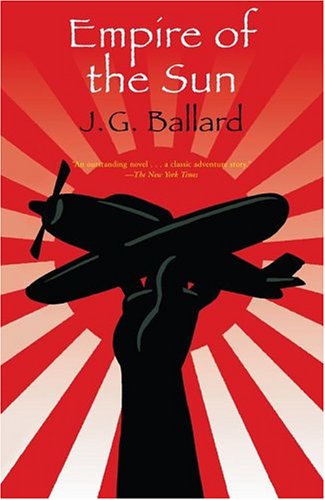
Review: Empire of the Sun


J.G. Ballard wrote Empire of the Sun in 1984, forty years after his imprisonment in a Japanese POW camp during WWII in Shanghai. The book is a novel, though it is based upon his experiences in Shanghai during the war. The story begins on the eve of the Pearl Harbour attack on the American fleet, and ends with the liberation of Shanghai by Allied forces. During this time, four years in total, the main character, Jim, grows from precocious school boy to hardened survivor, keeping alive any way he can in the harsh environment of the Lunghua prison camp.

This book is not a heartwarming tale. There is no redeeming action, the characters are not sympathetic, and there is no hope for the future, even after the war ends and those imprisoned are allowed to return to their former homes. It is the stark reality of a possible life inside enemy-occupied territory. Jim is emotionless throughout the story: there is no attachment, no sentimentality, no crying for home. It reminded me of Cormac McCarthy's The Road on more than one occasion, making the most disturbing part of the novel not the brutal realities that Jim faced, but Ballard's statement in the foreward: "For the most part this novel is an eyewitness account of events I observed during the Japanese occupation of Shanghai and within the camp at Lunghua." Even for those interested in stories about the Second World War, I would not recommend it. It is harsh, bleak, sickening and, as mentioned before, brutal. I suppose, that being said, Ballard succeeds, as war is all of those things and more, more than we could possibly imagine. Two and a half toy fighter planes out of five.

Thursday, May 28, 2009

Review: Fool

It's been a while since I read this, but a month has given me time to ruminate. I really enjoyed Fool, from the bawdyness to the convenient plot twists to the clever dialogue. Moore admits at the beginning of the book that he is trying to write a Shakespearean story in a Shakespearean manner, hence the puns and convenience. He weaves in and out of King Lear, adding elements (Macbeth's witches) and changing some to make for a better ending. But Pocket is a classic character, at once a social critic and performer, much like the fools present in Shakespeare's plays: he is always on for his crowd, and his performances reveal more about the audience than they realize or are willing to admit. Knowing the truth behind his actions and his personality is a little like looking behind the curtain, but more like Looking for Richard than Wizard of Oz. We know he is deliberate and calculated with his act, yet its effect is still surprising.
Moore's novel is hilarious, too. He lives up to his reputation as a humorist - one of his novels was recently selected as the #1 book to make you laugh by the CBC Book Club - with insane characters and devilish shenanigans. And jokes, too - many of Pocket's witty phrases are indeed as funny as anything Shakespeare wrote.
My overall opinion is that if you have ever laughed out loud whilst reading a Shakespeare play, you will like this book. You also need a stomach for extreme bawdyness, as Moore does not spare any detail or leave an innuendo unturned. Enjoyable - looking forward to reading more of Moore.

*Update*: Unbound! has recently reviewed Fool, and has also read a couple of others that might be worth a read. I'm leaning toward Lamb as my next Christopher Moore pick.

Thursday, March 26, 2009

Review: Through Black Spruce

Joseph Boyden’s follow-up to critically acclaimed Three Day Road does not disappoint. Told from the point of view of alternating narrators Will Bird and his niece Annie, Boyden’s tale unfolds from end to beginning – we see the present before the past, leaving only the why. The two stories are interwoven seamlessly, each narrator providing a unique voice to the events that transpired. Will’s story is about redemption, as he finds his true self among the trees and traplines of his younger self, coming to terms with past events that set his life down a predictable and tragic path. However, he does so while in a coma, reciting the story in his dreams while his family and friends wait patiently for him to wake up. Annie tells her story to Will during solitary visits to the hospital, coming to terms with her past by reconnecting with her roots – the old traplines, the hunting cabin, the ice road. Her life is just beginning – she has yet to make any decision that cannot be remedied.
Boyden gives the physical environment a prominent role just behind the characters, making its place in the story as important as it would be in actuality to the characters. It is part of the way of life for these characters, living off the land. Annie seems most ill at ease when she’s in New York, spending money and dressing to the nines, but when she’s back in Moosonee, living in the winter cabin, trapping and hunting, she’s comfortable. Will, too: he can be ready to live off the land in a short time, settling his affairs and relying on the things he learned from his father. The title phrase “through black spruce” comes up again and again, a metaphor for many aspects of Aboriginal life, from literally returning from the bush and wilderness to experiencing personal revelation and understanding.
Boyden’s beautiful prose style only adds to the gripping story. It is a great read, and he is a great Canadian writer, taking features of the Canadian landscape such as thick spruce trees and polar bears or the effect of residential schools on the Aboriginal population and telling a poignant and forceful story. Four and a half marten pelts out of five.

Saturday, February 28, 2009

Review: The Curious Case of Benjamin Button

In my introduction to this selection, I found a quote from Fitzgerald stating that the idea for this short novella came from a quote of Mark Twain that “it was a pity that the best part of life came at the beginning and the worst part at the end.” So, is it better to age oppositely, so that you are born with life’s experiences and an aged body and then as your chronological age increases, your physical age decreases? The Curious Case of Benjamin Button seeks to answer that question.
The story begins with the Buttons, a well-to-do couple on the up-and-up with every advantage ahead of them. The next phase is a family, but when Benjamin is born, it is utter disaster for Mr. Roger Button: “A grotesque picture formed itself with dreadful clarity before the eyes of the tortured man – a picture of himself walking through the crowded streets of the city with this appalling apparition stalked by his side.” For Benjamin Button was born “an old man apparently about seventy years of age.” The story progresses with Benjamin on the outside for his entire life, from spending quality time with his grandfather sitting on the porch in his first decade to playing with kindergartners while in his 70s. He is never fully accepted by his family or his peers, and spends much his time sad and alone. In fact, the only truly happy time in his life was in his middle years, when his actual age closely matched his physical age.
Fitzgerald’s answer, then, is that your life would be worse if lived oppositely – always an outcast, always hiding who you are, constantly frustrated by an inability to reconcile his desires to his capabilities, poignantly illustrated as he nears the end of his life, looking like a small child: “He went back a third year to kindergarten, but he was too little now to understand what the bright shining strips of paper were for. He cried because the other boys were bigger than he and he was afraid of them. The teacher talked to him, but though he tried to understand he could not understand at all.”
Fitzgerald omits many details in this story, such as his mother’s name, but there was a repeated emphasis that everyone must act his or her own age, with Benjamin’s father and son looking foolishly narrow-minded in their embarrassment of Benjamin. I saw two points raised by this story: one, that given a change from the norm, i.e. a man who ages backwards, compassion and understanding should still be at the fore of everyone involved, rather than the anger and embarrassment that punished Benjamin for the “affliction” he had no say over. Secondly, Fitzgerald shows that age and experience are necessarily tied together. One cannot have the wisdom of experience without the experience itself. And so, to wish that you were young again is a thought gained through the wisdom of having experienced being young, and makes it impossible to have that experience again. Mark Twain, you are but wrong.
Interesting read, though only 82 pages. If it were longer, I would give it a pass, but because it is so short, I will give it a recommendation. Three bottles of hair dye out of five.

Sunday, January 18, 2009

Review: Reading Lolita in Tehran

Reading Lolita in Tehran is an important read for Western audiences. Azar Nafisi presents an overall picture of oppression, persecution and terror in the Islamic Republic of Iran. She describes her life in Tehran from the beginning of the Revolution – along with the majority of her compatriots, she was hopeful for the future – to the moment she leaves once and for all for America. She is oppressed in two ways: first, as a woman living in a fundamentalist Islamic state, where one by one her personal rights and freedoms are taken away, and secondly as an academic.
She was forced to resign from the university where she worked when she refused to wear the veil in the workplace, a decision which became moot when the government soon made it illegal for women to be seen in public at all without the veil. Women could only be seen in public accompanied by her husband, father or brother; unaccompanied women faced all sorts of difficulties. Married women had little or no rights: even custody of children was granted to fathers in cases of divorce. The University of Tehran had a secondary entrance for women, where they were subjected to rigorous and humiliating searches and inspections to ensure that they were acceptable. This alone seems altogether unbearable.
But Nafisi was also an academic. Her ability to teach university students is quickly limited until she can no longer teach the texts she wants in the way she wants. She is primarily a Western scholar, specializing in Nabokov, Fitzgerald, James and Austen; each of these authors come under strict scrutiny until she can no longer find copies of their works in any bookstores in Iran. The majority of her students have photocopied versions of old texts. Sadly, she recounts how booksellers were first forbidden to sell these works, and how the Revolutionary Guard came and removed any extant copies and arrested the bookstore owners, and then even to possess such works was illegal. As a scholar, this was an impossible environment.
Such is the historical backdrop of Reading Lolita in Tehran. She conducts a secret class of female students interested in discussing Western novels unrestricted by law or social pressure. The class came to be a safe haven for the students, Nafisi a mentor. They came to discover themselves as women and as scholars and ultimately decide for themselves how they would proceed with their lives in such an oppressive environment. Nafisi admits that she changes and borrows events and facts to create certain characteristics, giving the western eye a snapshot of what life is like for women in Iran. The characters range from young and inexperienced to sexually liberal to devout to loyal to the regime. In the end, while the reader wishes all women in Iran had the ability and chance to escape such oppression, Nafisi gives us reasons for staying as well as for leaving. She asks, how can our country change if all the people committed to change leave? She also has personal feeling s of guilt, as she had become a mentor to these young women: “I felt guilty enough on my own, as if my decision to leave was a betrayal of some promise I had made to them.” It is not such an easy decision to leave when looking at both sides of the story: for every Azar Nafisi that leaves, thousands are forced to stay and endure, clinging to whatever hope they can piece together to get through the days. And Nafisi provided some of this hope to her students.
The structure of Reading Lolita in Tehran is intriguing, pairing a novel or author with a period of her life in Iran and drawing parallels to her own life and that of the author’s or those of the characters she studies. Hence, Lolita is courageous, not a tramp but an enduring victim, The Great Gatsby is revolutionary, Henry James’s Daisy Miller is courageous in her fatal choices that were at least her own, and Austen demonstrated the hope that literature and imagination can provide.
I enjoyed this book, though it was certainly exhausting to read of the plight that so many women faced at that time (and still today – the Taliban in Afghanistan is torturing young women who choose to go to school!). Nafisi’s main point is this: through literature, through imagination, we can all feel hope and freedom, if only for a moment. As she says of Pride and Prejudice, “All we needed was to read and appreciate the cacophony of voices to understand its democratic imperative. This was where Austen’s danger lay.” Four forbidden texts out of five.

Wednesday, December 03, 2008

Spooky Troutmans: A Mash-Up Review

So, I finished Spook Country over a month ago but couldn't bring myself to write a review. On the positive side, it helped me get to get to sleep quite quickly and I felt like a speed reader because I could blast through the three page chapters in no time. Overall, though, I have to give it a giant thumbs down/wag of the finger. It was too long and too slow and ultimately terribly unsatisfying. Gibson seemed to be experimenting with narrative and perhaps subverting the reader's expectations, but he needs to further refine this approach. One broasted potato out of five.

I enjoyed Miriam Toews's The Flying Troutmans just as much as I liked her previous books. Her ability to combine humour with the small tragedies of ordinary lives is remarkable and she creates rounded, believable characters. I'm not sure how I feel about the ending - Hattie's decision to go back to Min with Thebes seems naive and the family's desperate need to create and maintain a relationship with Min will, it seems, only cause them further pain. I think Min is far more dangerous to those around her than anyone, except perhaps for Logan, is willing to admit. I suspect that Min was the cause of Logan's scar, which casts her and her role as a parent and caregiver in an entirely different light. Of course, the question of whether Min will be alive when Hattie and Thebes return to Winnipeg remains, and the uncertainty regarding the future lends to the sense of realism in the novel. Overall, a good, thought-provoking read.

Friday, November 21, 2008

Review: The Flying Troutmans

Miriam Toews’ The Flying Troutmans is a delightful read. The three characters, Hattie, Logan and Thebes, embark on a road trip to find the kids’ father after their mother has a psychotic breakdown. Hattie suggests this because a) she doesn’t know if she can (or wants to) take care of them and b) because she doesn’t know what else to do.
Two things happen to Hattie during this road trip. First, she learns how to take care of these kids. She initially attempts to take their mother’s place but quickly realizes that that these kids are too smart for that. Instead, she learns from them how best to lead the next stage of their lives. She’ll take care of them but she won’t tell them what to do. Second, she learns how to care of her sister. Her childhood was dominated by an intense fear of Min, both for what she might do to herself and for what she might do to her; Hattie’s life is and always will be dominated by her sister. Hattie embraces this fact, and though this may seem sad, it is really for herself that she must do this.
The kids, too, learn how to take care of their mother. Logan seems to be the most mature 15-year-old in history – he deliberately creates extreme situations to expedite his own maturing process; by the end, he is ready to care for his sister(s) and mother. Thebes, on the other hand, is born 40 and acts how she thinks an 11-year-old should act. It is all in preparation for what is to come.
Toews is a great writer – tight, flowing prose with tangents inserted at the right moments and dialogue that is efficient but always genuine; there are no long passages about the meaning of life in Toews’ books. Instead, the characters bring a sense of what life is – or what purpose is – through their experiences. The book has a happy ending but doesn’t descend into cliché or convenience.
I thoroughly enjoyed this book and give it five oversize novelty cheques out of five.