Showing posts with label memoir. Show all posts

Sunday, November 11, 2012

Remembering Our Soldiers

Today is Remembrance Day in Canada, and at 11:11 we will remember those who have given their lives to protecting our country and those who continue to do so. I would like to especially thank my family members who have served in the Armed Forces - please know that I think of you often and I am always in awe.

If you need a few ideas for Remembrance Day reading, I highly suggest The Missing of the Somme by Geoff Dyer. It is a quasi-memoir/novella about his own research into his grandfather's participation in the First World War. He brings the soldiers of that war to life, giving them voices and recreating, on an emotional level, the experience of a country at war - not only soldiers travelling to the front and expecting to be home by Christmas, but those left behind trying to make sense of what is happening and fearing for their loved ones; and, after the war is over, those same loved ones returning home changed forever. It is a powerful book and Dyer is intense and blunt with his observations. Worth a read.

Friday, October 19, 2012

Neil Young and Meta-Memoir

I've been quite curious about the new Neil Young memoir since it came out earlier this month. I have been a Neil Young fan for a long time - Rust Never Sleeps is easily one of the best rock & roll records of all time; Harvest, Harvest Moon, Everybody Knows This is Nowhere - the list goes on. As well, the concert film Heart of Gold is fantastic, and a new concert film, Neil Young Journeys, is also out this month. He released Neil Young Archives, Vol 1: 1963-1972 a few years ago - home recordings, early demos, personal stuff. So it is natural to think that his memoir would be illuminating - Young is looking back on his life and career, and has the desire to share it with his fans.

I listened to Neil Young on NPR's Fresh Air a couple of weeks ago - and however astute and interviewer Terry Gross is, Neil Young was still, well, Neil Young, as mysterious and reluctant to share as ever. Perhaps he isn't reluctant to share, just reluctant to submit to someone else's terms. Levi Asher at Literary Kicks thinks so, too. His latest blog post is titled "Neil Young's Book Is Not a Great Memoir, But It's a Great Something":
A memoir? Waging Heavy Peace is a stream-of-consciousness, sucking in to itself like a vortex every thought, idea, opinion, business plan, musical memory, old grudge, old friendship or hilarious observation that flits past Neil's eyes as he sits there trying to write. Heavy Peace is a highly self-conscious work -- meta-memoir, to be sure -- and Neil does not seem happy about the fact that he has committed to writing an autobiography, even though he did so of his own free will. He swerves crazily, like a drunken bus driver on a mountain trail, between past and present tense, between the 1960s and the 1980s and now, between technology talk and random memories and musical explanations and tributes to his long-lost friends. The book will keep you awake and amused, but it won't deliver the punch of truth and honesty that a great memoir should deliver, and that recent books by Bob Dylan, Keith Richards and Patti Smith all delivered.
The rest of the article is a great review of the book - I am still intrigued about the book; however, when I read it, I won't be looking for answers.


Friday, September 28, 2012

Jian Ghomeshi's Musical Life

Each Friday, I have noticed, I have mentioned something relating to music with my posts. Today, I am cheating a little, as I came across the Maclean’s review of Jian Ghomeshi’s memoir 1982:
The book suffers from one rather large problem: it is addressed to teenagers who will probably not appreciate most of its cultural references. His subject is the timeless teenage quest to be cool, but at times the book feels like an excuse to write about his favourite ’80s bands. The wafer-thin storyline—loser likes girl, gets hip, gets girl—punctuates far richer tributes to the tunes of David Bowie, the Clash, and Talking Heads. Ghomeshi had crushes on girls, but he loved music.
Andrew Stobo Sniderman feels that the book does not succeed as it intends. As a memoir, it is only effective if the subject can create empathy with its readers. With such a fixed time frame (the title should be a giveaway), this book may only appeal to, as Sniderman suggests, those who are old enough to remember this era. However, music fans of all ages should be able to close that gap quite easily. For instance, another writer that I appreciate, Jonathan Lethem, wrote a book dedicated to Talking Heads’s Fear of Music for 33⅓. It is an excellent book about an excellent album, one of my favourites (both the book and the album). Lethem carefully explicates each song based on its musical, lyrical, cultural and artistic merits. I listened to the album several times over while reading this book. His love of the album clearly shows in his writing.

Of course, Lethem’s experience with the album is listening to it for the first time when it came out, on vinyl, when he was a teenager. His attachment to the album are tied with growing up, attending his first Talking Heads concert, sharing the music with friends and strangers. My experience, certainly, is different than his, separated by time and distance. I will never be able to experience Talking Heads live in concert, nor can I replicate the experience of listening to the album for the first time as a moody teenager. But I had a similar response, even though our initial experiences were so different. It elicited memories of my own teenage years, as I remembered listening to R.E.M., U2, Nirvana, etc. for the first time. I have Cameron Crowe to thank for my first listen of Blood on the Tracks, as he used "Shelter From the Storm" in his film Jerry Maguire. After I saw that movie, I came home and search through my dad’s vinyl collection until I came to Blood on the Tracks, and proceeded to listen to the album several times over start to finish. I will never have the experience of hearing Dylan for the very first time, as listeners in the ‘60s would have. But I would argue that I will have a similar experience in listening to Dylan, and as I get older the experience of listening to Dylan’s music changes as my life does.

I am intrigued now by Jian Ghomeshi’s memoir, as he seems to connect the important times in his life to the music that was on in the background. Just like me.

Friday, August 17, 2012

The Rock Memoir

Memoir has enjoyed a renaissance of late (well, the last 10 years), and no genre has benefited more than the rock memoir. Seemingly inconsequential figures in music history come out of the woodwork to write about the experience - as if just being a musician entitles you to a better life story than other working people. However, there are some truly great books amid the sludge. Some are great simply because the subjects are true geniuses; some are interesting tell-alls; and some are just truly great life stories, written by people who happen to be musicians. Rob Sheffield at Rolling Stone, a great writer himself, catalogues 25 such books here. Surprisingly, music fan that I am, haven't read any of them, though I do own several. Perhaps one of these titles will be a future book club selection.

Friday, May 29, 2009

Top 10 Memoirs

CBC Book Club readers have voted on a top ten memoirs list. It's filled with popular titles from the last few years, such as Glass Castle and A Year of Magical Thinking, but also a couple of new ones, like Nothing to be Frightened of by Julian Barnes, released earlier this year. There are classics, too: Anne Frank and Maya Angelou made the list. A good starting point for non-biography readers, I think. Perhaps we'll use this as a launching point for book club suggestions in the future.


The Top 10 Memoirs | Blogs | CBC Book Club | CBC.ca — CBC Radio

Sunday, April 12, 2009

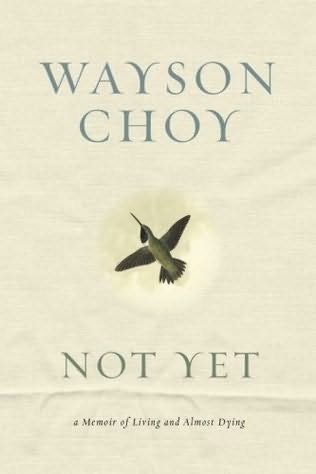
Review: Not Yet

Not Yet: A Memoir of Living and Almost Dying - Wayson Choy

Wayson Choy's newest book chronicles his brush with death after a heart attack in 2001. He was kept in a medically-induced coma for four days and spent several months in the hospital afterward. It was a traumatic event that made him think about his life, his family, and himself.
Choy is quite candid in this account of his illness, reporting everything from learning to walk again to becoming aroused during a tissue massage (that part he probably could've skipped). However, the proof is in the details, and the story of his recovery would not have been as poignant or sympathetic had he not bared his soul in this way. We learn of the close, close friends that are his family and the circumstances leading to those same relationships. As the Random House official page reports, "Not Yet is a passionate, sensitive, and beautiful exploration of the importance of family, which in Choy’s case is constituted not through blood but through love. It is also a quiet manifesto for embracing life, not blind to our mortality, but knowing how lucky we are for each day that comes." Highly recommended.