Showing posts with label September. Show all posts

Saturday, September 29, 2012

Nazis. I Hate These Guys.

It’s the end of the month, and so it’s time for my review of September’s book club pick, March Violets by Philip Kerr.

March Violets is a very good novel in a series featuring private detective Bernie Guenther. Bernie is a former Berlin police detective, but after several cases turned up corruption in the department, he left the force to open his own agency. Now, he is asked to investigate a missing necklace that is embroiled in corruption, betrayal, murder, skeletons in the closet and the Gestapo. Did I mention Nazis? Bernie usually stays out of cases that might involve the secret police or step on the toes of the Berlin criminal police, the kripo, but in this instance he is in the thick of it from the get go. He investigates the missing necklace and soon discovers one secret after another. He is a better detective than his client expected, and with each discovery, Bernie is deeper into the corruption that is rampant in Nazi Germany, to the point where he is a pawn in the power struggle between Goering and Himmler themselves. Goering is actually a major player in the turn of events that leads to the answers Bernie seeks.

This novel is not for the faint of heart. Kerr takes the cliche gumshoe and puts him deep in the heart of Nazi Germany in 1936, adding to the usual dangers that befits the private eye. Not only does Bernie deal with shady clients, corrupt police, and the Mob, but also Nazis. To update the travails of the classic noir detective, Kerr increases the level of violence and desperation. When I was researching this novel, I read a blog that compared it to The Girl With the Dragon Tattoo (which, of course, I can’t find now), and I would agree in the sense that the level of violence is very similar. The shocking rape and torture scenes of GWTDT would fit in quite well in March Violets - there are a couple of scenes that are quite similar. To ensure that you don’t forget that you are reading about Nazis, Bernie is sent to Dachau, and he witnesses first hand the atrocities against the prisoners.

The novel is a gripping story from start to finish. Kerr adheres to the tradition of noir fiction, specifically the self-defeating protagonist; on several occasions, Bernie gets himself into further trouble simply because his pride is wounded and he feels compelled to respond in kind. As well, Bernie is a romantic possibility with each eligible female character, another noir staple. The mystery at the heart of the story is a straightforward tale of half-truths and secrets, and no character is as they seem at the outset. However, where Kerr shines is in replicating the anxiety, tension and fear of Berlin under those conditions. It’s not quite wartime yet, but it’s not exactly peacetime for the citizens of Germany in 1936. "March violets" is a term referring to this atmosphere, describing those members of the Nazi party who signed up in March 1933, just months before new membership was suspended. If you were not a member of the party by that point, your future in Germany was limited and potentially dangerous.

I would recommend it for mystery fans, certainly fans of Stieg Larsson or other dark mystery writers such as Michael Connelly or Ian Rankin. It may also appeal to historical fiction fans, especially fans of World War II novels. However, it is quite graphic in some scenes, so heads up. Three missing necklaces out of five.

Wednesday, September 05, 2012

September's Pick: March Violets

This month's selection is dictated more by lack of selection than actual choice. Our books are boxed up and waiting arrival to our new place. We have a couple of books with us in the meantime, one of which will be our September pick:

March Violets by Philip Kerr

Book one of the Berlin Noir trilogy, March Violets introduces "hard-boiled" private detective Bernie Gunther in the violent pre-war period in Berlin. He's "sardonic, tough-talking, and cynical" and sets himself against the Nazis in an investigation into a high stakes murder. It's Hammett, it's Chandler, it's Indiana Jones - it should be fun.

Read more at Philip Kerr's official website.

Monday, August 31, 2009

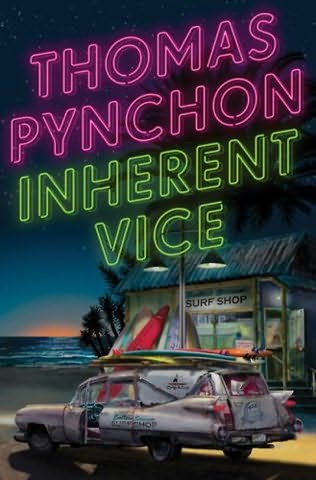
September's Pick: Inherent Vice

As August comes to a close, I have been thinking about which books to choose for our monthly poll. However, I have made a decision for the group, and it's entirely selfish: September's book will be Inherent Vice by Thomas Pynchon. Pynchon's latest novel, which can be described very briefly as a stoner gumshoe mystery, seems to baffle most critics: some expect Pynchon's postmodern leanings to come out in full force, i.e. the more complicated and confusing the better, and some like the idea of a straightforward murder mystery. It seems that Inherent Vice is somewhere in between. I am intrigued enough to find out for myself. The review on The Millions (yes, I am their greatest fan) is necessarily ambiguous, but it features a video trailer for the book that is, I believe, narrated by Tommy Chong, of Cheech & Chong fame. Which would make sense.

In other news, keep chugging away at A Prayer for Owen Meany, people! I am not yet done myself, but I will be shortly. It is proving to be a difficult one to get through, not the summer read I expected at the beginning of July. At any rate, my review will be here sometime in September.

Wednesday, December 03, 2008

Spooky Troutmans: A Mash-Up Review

So, I finished Spook Country over a month ago but couldn't bring myself to write a review. On the positive side, it helped me get to get to sleep quite quickly and I felt like a speed reader because I could blast through the three page chapters in no time. Overall, though, I have to give it a giant thumbs down/wag of the finger. It was too long and too slow and ultimately terribly unsatisfying. Gibson seemed to be experimenting with narrative and perhaps subverting the reader's expectations, but he needs to further refine this approach. One broasted potato out of five.

I enjoyed Miriam Toews's The Flying Troutmans just as much as I liked her previous books. Her ability to combine humour with the small tragedies of ordinary lives is remarkable and she creates rounded, believable characters. I'm not sure how I feel about the ending - Hattie's decision to go back to Min with Thebes seems naive and the family's desperate need to create and maintain a relationship with Min will, it seems, only cause them further pain. I think Min is far more dangerous to those around her than anyone, except perhaps for Logan, is willing to admit. I suspect that Min was the cause of Logan's scar, which casts her and her role as a parent and caregiver in an entirely different light. Of course, the question of whether Min will be alive when Hattie and Thebes return to Winnipeg remains, and the uncertainty regarding the future lends to the sense of realism in the novel. Overall, a good, thought-provoking read.

Sunday, November 02, 2008

Spook Country is subversive - I think

I finally finished William Gibson’s Spook Country, just in time for the beginning of the month and a new book. I was curiously satisfied by this book – though it may have had to do with the fact that I read the first half well before the second half. My initial reaction is that the book could have been just as well told if it were only the second half – the events in Vancouver, perhaps. The story itself is somewhat interesting – subverting corrupt players in the world war game. My feeling is that Hubertus Bigend is one of those players, using Hollis Henry to get to Bobby Chombo to get to his employers.

But the most interesting aspects of the book are underexplored. First, there’s Bobby’s day job, creating software for “locative” art pieces – virtual reality art installations made possible via geohacking and vr visors. The pieces are only visible in specific locations and only with a visor – and the locations themselves are central to the piece. It is an interesting idea in itself, one well worth exploring further. But Gibson is not telling that story.

Another story he does not tell is that of Hollis Henry and the Curfew, the now-defunct rock/punk band echoing The Clash, I presume. Hollis is a rock star turned journalist, recruited specifically for this piece on locative art which is really just a way to get to the bigger story. Bigend uses Hollis’s celebrity to open doors he could not. As a result, the story of her life before Node is not told here. It seems such a promising idea that Gibson, were he, say, Chuck Klosterman, could write another novel entirely. Her character is the most engaging part of the novel, and the reason the story seems more interesting than it actually is. But leaving so many questions about her past is not so much mysterious as frustrating.

Spook Country was about 100 pages too long, certainly, and Gibson spends a disproportionate amount of time on less than consequential characters. Milgrim? Brown? Tito? Why so much attention paid to these characters? In the end, Hollis’ story, which I presume is the main story, isn’t impacted at all by any of these characters, yet Gibson tells their stories as though they are central to the plot. Perhaps this is the subversive nature of the novel: by leading us in one direction and then ending in another, Gibson is playing on the suspicion and fabrication of his characters to lead his readers astray. Perhaps I am affording Gibson some skill as a story teller that he does not have, for either he was trying to pull this off and falls short or he was trying for something altogether different and I missed it. Either way, this book was a struggle to get into and the payoff was nothing to write home about.As Hollis says at the end of it all, "I think that it was actually... a prank."

2.5 turquoise shipping containers out of five.

Monday, October 27, 2008

Spooked

So after two months of trying I have officially given up on William Gibson's Spook Country.

I made it to page 165 or thereabouts but after falling asleep after three-page chapters several nights in a row I decided to end the affair.

I tried... and though I enjoyed the character of Hollis Henry, even a rock star turned journalist couldn't keep me reading.

Tito's espionage missions were boring and Milgrim's amphetamine addiction and obscure references to cryptography were lost on me.

According to the NY Times, Gibson is playing on the word “spook” throughout the novel:
...not just in the slang sense of a spy, but also in the more traditional sense of a ghost — of figures who pass through the world unnoticed and unrecognized, and who are about to find out how empowering anonymity can be.
Well, unnoticed and unrecognized just so happens to describes this book, too, I'm afraid.

Sorry Mr. Gibson, the futurist turned modernist turned newest member of the dusty bottom shelf of my bookshelf: I can't get behind that.

The Flying Troutmans... here I come.

Monday, September 01, 2008

September's Pick: Spook Country

September 1st is not technically the end of summer, but it is a good enough time to get the ol' book club started once again. The Siege of Krishnapur was the victim of circumstances, being the summer selection, and has been abandoned. We're not quitters, just realists. That book was never going to be read.
So on to the first book of the new era: Spook Country by William Gibson. Gibson's latest book (and newly in paperback) is about, well, I am not sure what it is about. But The Washington Post calls it "a devastatingly precise reflection of the American zeitgeist." And Hutty's already started it and has given it two thumbs up. Gibson's claim to fame thus far is coining the term "cyberspace" in his novel Neuromancer, which, according to Gibson's website, is "the novel that started it all, launching the cyberpunk generation." Learn more about Gibson from his website: www.williamgibsonbooks.com.


Spook Country.We'll read through September and then discuss toward the end of the month. Around the middle of the month, let's start pitching ideas for the next book. And then we'll vote.

Saturday, June 07, 2008

June's Pick: The Siege of Krishnapur

After a false start and a new suggestion, we have all decided on The Siege of Krishnapur by J.G. Farrell as our next club selection. It's about war, so that's good, and it is on the shortlist for the Best of Booker prize to be handed out later this summer. Happy reading everyone! While we're waiting for everyone to read and review the book, feel free to post thoughts on everything from movies to the NBA Finals. Just keep it manly. That means no reviews of the Sex and the City movie - I'm looking at you, Hutty. And keep those thinking caps on for suggestions for July's selection.

UPDATE: The Siege of Krishnapur turned out to be our "Summer 2008" selection rather than a strictly "June" selection.